Showing posts with label MTA. Show all posts

Saturday, August 27, 2011

Hurricane Irene

This is a dynamic post (will be updated if possible).  For current post, click on "Read More"
General information
  • Projected to hit NYC as a Category 1 hurricane Sunday morning.
  • Track the hurricane, along with other data via Google's

Wednesday, May 19, 2010

Happy 200!!!

HAPPY 200th PUBLISHED POST!!!!!
Yes, the 200th post is finally here and is a confirmation that I am still alive. Apologies for the extremely long hiatus since my last official post on 11/11/09, school work and a sense of lethargy on writing a blog that no one really reads made me reluctant to continue blogging. However, with Summer break here and a enormous list of bookmarked websites and news articles in my browser's "ToBePosted" folder have persuaded me to resume. Although I will try my best to include everything I have wanted to talk about (politics, entertainment, rants), I can only include items that have been preserved in that aforementioned bookmark folder; stuff I thought about while in the shower maybe forever lost to time. Details/opinions may also be brief. I will also add a date to give it some context.

Now, on to the celebrations! A quick recap of the last 100 posts! (The 100th post was published 2/5/09.) Get ready for a barrage of hyperlinks but trust me, it is worth the read:
Here's to another 100 and thank you for stopping by and hope to see you again soon!


Post 200 Dated 5/19/10, see 200th post for reason
Comment below! - and leave an ID/email to get replies Creative Commons License

Tuesday, September 8, 2009

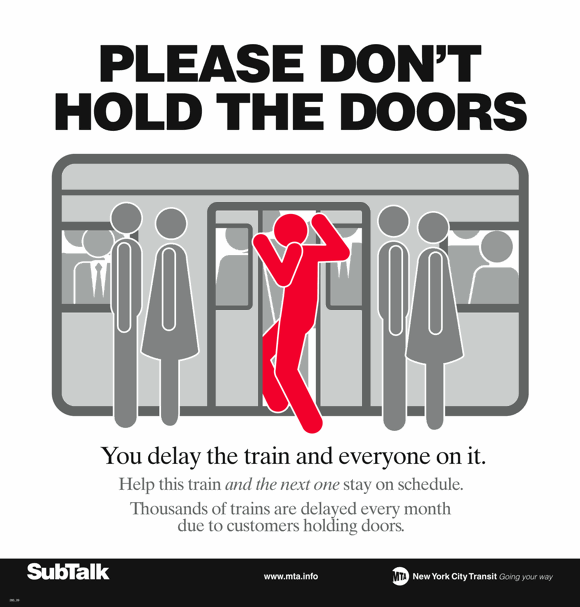
New MTA Ads for Door Blockers Ineffective

Don't Hold the Doors: MTA, Second Avenue Sagas

I saw the above ad the MTA installed as part of its renewed PR campaign to stop door blockers on subway trains today. It was located inside of the subway car, on a square ad located next to a door. Then I realized something as a passenger blocked the door with his arm and held it there for 5 seconds before the conductor relented and reopened the doors. Shouldn't the ads be placed on the windows of the doors or to its sides on the EXTERIOR of the train instead? Using a sticker for the door or to its sides would allow passengers rushing to the train from the platform to see the "Please Don't Hold the Doors" sign and may actually do just that. Instead, they will only see the ad after they have successfully delayed the train and the ones behind it.

Post 167/173
Comment below! - and leave an ID/email to get replies
Creative Commons License

Thursday, August 20, 2009

Shame on TWU Local 100

The MTA just got screwed. Again. Last Monday, an arbitration panel declared that the Transport Workers' Union, the union that represents train drivers, conductors, and bus drivers, would be able to receive a 11.3% raise in the next 3 years, for a total of $350 million, something that the MTA just cannot afford in these times. Their deficit is projected to be $10 Billion in the next 5 years. The Union claims that these pay raises are on par with some city workers' unions that got 4% raises. Mayor Bloomberg's rebuttal: "The city's finances are different than the MTA's finances, the city's workforce is different. So there's no reason to think that if one does something, the others automatically have to get it." To make things worse, they also won the right to not have to increase healthcare contributions for the next 3 years-currently at 1.5%, as well as not having to pay that cost on overtime pay. This was something that was negotiated out from the 2005 illegal transit strike. In addition, the MTA now has to postpone the initiation of One Person Train Operation (OPTO) to the year 2012, something where a train does not have a conductor on board but only the driver, already present on numerous train systems throughout the world. This would have saved the MTA millions in operating costs, not to mention the investment in new technology to make OPTO happen over the past few years. Now the MTA's future, as well as the economy of the city, is at even greater stake. Unions.

Post 155/161
Comment below! - and leave an ID/email to get replies
This blog is now:Creative Commons License

Friday, August 14, 2009

MTA: 7 Line Getting CBTC and T Stands for Torture

Part 5 of Week-long Series on Mass Transit in NYC

After the relative success of computerizing train operations on the L line, the MTA is set to do the same with the IRT 7 line. Computer Based Train Control, or CBTC, allows new trains to sync with signals and a computer that better allows trains to run closer together while increasing safety and reliability. The technology also allows the feasibility of next train arrival information, currently in use on the L line. LED monitors display approximately when the next train will arrive, although my recent experiences with these monitors have shown that they are still a little off. CBTC also allows One Person Train Operation, OPTO, and worries about safety are offset by its common use throughout metro systems around the world. This helps save the cash-strapped MTA money without jeopardizing the safety of passengers, since the train driver/engineer can now take on the role of conductor without having to worry about driving the train as much. Of course, the Unions are always getting in the way of progress, and frankly they need to recognize that if they want to keep their jobs, then they should let the MTA save the money to do so.

And speaking of progress, the Second Avenue Subway is on its way!...after 70 years in the making. But will it be opened in my lifetime? I doubt it: Judge for yourself, with New York Magazine's timeline titled, "The Long, Tortured History of the Second Avenue Subway."

Post 152/158
Comment below! - and leave an ID/email to get replies
Creative Commons License

Thursday, August 13, 2009

6 Train's Moving on Down (for Uptowners)

Part 4 of Week-long Series on Mass Transit in NYC

Let's take a train ride on the New York City Subway, shall we? Let's say that you're taking the F from Delancey St and want to go to 42St/Grand Central. So you take the Queens-bound F all the way to 42St/Bryant Park, or transfer for an express B or D train at Broadway/Lafayette St. Then, another transfer to the Flushing-bound 7 train one stop. According to the MTA's Trip Planner, that will most likely take you 30 mins to travel 2.4 miles during rush hour. In the future, a new interchange point between the B, D, F, and V lines and the uptown 6 train may help cut that time to 26 minutes (and a lot less walking at the long tunnel between the 7 and F at Bryant Park). Currently, riders can only transfer between these two systems to/from the downtown 6 platform at Bleecker St, since the uptown platform is staggered "above" the downtown one. (Note: many IRT platforms in downtown Manhattan, most notably on the 6 train, are not connected.)

Image of Map with Current Travel vs Future Travel Route

Currently under construction is a new transfer area, escalators, and elevators to connect the uptown 6 platform to the rest of the complex. This is done by extending the uptown platform South and by excavating and by building an entirely new concourse below it. Expected completion date: 2011. The design is by architecture firm Lee Harris Pomeroy Architects, and it looks marvelous. (Of course, any new station or major rehabilitation is great compared to the state of most stations now.) It also has a signature "hive-like" LED artwork that will make passersby look up from their Blackberrys and iPhones for a minute-just hope they won't trip. Take a look for yourself:
>>>Lee Harris Pomeroy: Bleecker Station Expansion and Restoration
>>>Curbed: Soho, Noho Join Forces for Subway Super Station!

(Taken using MTA's Interactive Trip Planner, with Delancey St as start point, specifying F, and Grand Central as End point for a weekday 8:25 am departure.)

Published Post Number:151/157
Comment below! - and leave an ID/email to get replies

Wednesday, August 12, 2009

The Liberty Card: Coming Soon?

Part 3 of Week-long Series on Mass Transit in NYC

The Liberty Card does not exist...yet. My long time imaginary name for the ideal smartcard that would be used in the tri-state region for mass transit fare collection. (For those of you who take PATH, you have a similar card called the SmartLink. A smartcard is great: it uses Radio Frequency IDentification technology to allow contactless payment, getting rid of all that frustrating magnetic strip swiping currently used in the Metrocard system. If even New Yorkers can't always swipe it correctly the first time, all hope for tourists are lost (I've seen and experienced it). Just tap and go, and you barely have to put any effort into it-keep it in your wallet or jacket pocket, and as long as nothing majorly metallic or thick gets in between your card and the reader, you're guaranteed a smooth entry.

But smartcards do not stop at the turnstiles. In Hong Kong, where the Octopus card was first introduced in 1997, the possibilities for its use truly lives up to the number of legs of the animal referred to in its name. Acting as a debit card, with "top-ups" with either cash or a link to your bank account, it is the island city's most popular form of payment (10 million daily transactions), next to cash. Places you can use the Octopus card (and some potentially in NYC as well) include:
  1. Subway
  2. Bus/Light Buses
  3. Tram
  4. Convenience Stores
  5. Supermarkets
  6. Bakeries
  7. Fast-food restaurants
  8. Vending machines
  9. Parking meters
  10. Newspaper stands
  11. Secure entry points
Now, the question is: who would pay for the implementation of a smartcard? Most likely, the MTA, since it has the highest ridership in the region. However, their most recent budget forecast for the next 5 years is $10 billion short, and money is always constantly being diverted to cover shortfalls. The point could be made that since credit card companies such as Mastercard and Visa already have their own RFID-enabled cards, that the MTA should just let the credit card companies develope it. In fact, select stations in the NYC subway system already allow pre-registered users to use their card.

But the MTA should partner with the Port Authority of NY and NJ (which has the SmartLink) to either keep the SmartLink or develop a new card: LibertyCard. The MTA could make the card pay for itself! By implementing a debit-card like system with online account access, the card could be used at retailers similar to those mentioned above, with the MTA charging a credit card company-like fee per transaction. This would not only allow the usage of the card to pay for all the research and implementation costs, but also would give higher security to its users: riders, especially little kids and the elderly would no longer have to carry as much cash with them when they go out. In addition, if the smartcard is lost, it can be easily canceled/replaced without having to worry about your checking being emptied or credit being hurt. The MTA should seriously consider transitioning to a smartcard, but only after planning out a long term financial sustainability plan for its use so that it recoups the cost of its development and roll out that will also benefit New Yorkers and visitors immensely.

Read More: I was planning on blogging about this topic before, but just never got around to it, until I was reminded by 2nd Ave Sagas: The Future of the Metrocard Part 1, Part 2, Part 3, Part 4

Published Post Number:150/156
Comment below! - and leave an ID/email to get replies

Tuesday, August 11, 2009

Bloomberg Releases Mass Transit Plan

Part 2 of Week-long Series on Mass Transit in NYC

Bloomberg released his "wishlist" last week for New York City's mass transit improvements, giving another reason why New York City cannot afford to lose a mayor of his caliber in the upcoming mayoral election. Summary of his plans for improving mass transit:

1. Expand and Improve Service in Underserved Neighborhoods Via the Commuter Railroads
2. Fix Stations More Efficiently and Cost Effectively to Ensure Existing Stations Are in State of Good Repair
3. Reinstitute F Line Express Service (in Brooklyn)
4. Reopen the Staten Island North Shore Alignment
5. Pilot Light Rail or Street Car Service in Brooklyn and Western Queens Waterfront
Neighborhoods
6. Provide Subway Riders with Time Notifications
7. Expand Bus Rapid Transit (BRT) and Select Bus Service (SBS)
8. Provide Commuter Van Service to Neighborhoods Where Transit Service Fails to Meet the Community’s Needs (Comment: critical need in Northeastern Queens and Brooklyn)
9. Use Smaller Buses to Service Existing Routes During Less Crowded Periods
10. Provide Free Crosstown Buses on Select Routes (Comment: although the MTA will be spending less money running fewer buses because of reduced delays, they would end up losing money on these routes, despite the overwhelming convenience.)
11. Provide 50% of City Bus Routes with Tracking Technology by 2013 (Comment: MTA already gave
12. Provide Cheaper, Safer, Better Transportation for ParaTransit Riders

You can view his full report here: http://www.mikebloomberg.com/mass_transit_plan.pdf

Published Post Number:149/155
Comment below! - and leave an ID/email to get replies

Monday, August 10, 2009

Thoughts on MTA 2010-2014 Capital Program

Part 1 of Week-long Series on Mass Transit in NYC

This is an email sent to the New York City MTA in response to their draft of their 2010-2014 Capital Program, released today and found here: http://mta.info/mta/capitalprogram.html


Smartcard investments: although I have long pushed for the MTA to finally adopt this ubiquitous technology, unless the MTA finds ways to "profit" off smartcard usage, I think funding should instead be diverted to more pressing concerns. Profit=expanding usage to merchants such as supermarkets, convenience stores, news stands, etc., like a debit card. People that don't have credit cards (ex. youth) would be able to use it at other places without having to carry cash around. MTA could charge a fee to merchants, like the credit card companies do, at 3rd party places. Octopus Card is a good example. And if smartcard is ever put into place, please do not drag out process of allowing Metrocards to continue to be used like what happened with the token back in the '90s.

Page 8: Sustainable Investments-despite the economic downturn and credit "freeze", the MTA should also expand their property ownership around new and existing stations. A good example: Hong Kong MTR-through their MTR Properties, they have hugely successful commercial and residential developments on top of or going into stations, creating an easy and direct connection to the transit system as well as an interconnected area.

More ventilation at platform level-perhaps keeping the hot air from the trains from wafting into the platform? Or employ A/C units similar to
Grand Central's 4/5/6 platform.

New buses with push-bar rear exit opening tech is GREAT! But news of eliminating the push button on new Orions is not...

HEETs are not as efficient as traditional turnstiles and are in fact more dangerous and moves traffic slower-when a load of people are getting off a train, it's scary walking into swinging metal bars coming at you.

Using new tunnel lighting is great, especially with CFLs or (maybe with a very generous sponsor?) LEDs. But too much lighting is inefficient lighting-take the tunnel on E/V at 53St/Lex. There is way too much lighting there for illumination-similar to what an at grade tunnel would have.

Commendations on finally getting Herald Square escalators working after nearly a 6 month out of service period-image is everything to riders.

7 is getting R142's? I thought it was R179s? And if it is 179s, you should definitely consider having the R143's LED message boards along with 160 FIND maps...LEDMB=ad space.

What happened to your deal with CNN on televisions on platforms? I truly would love to see this deal go forward- AD REVENUE for MTA; TVs should face platform from tracks; MTA announcements as well; vandalproof.

And more PR - reaching out to public with Youtube? Twitter? Using Youtube, MTA could publish videos about construction progress, Did You Knows?, service interruptions, and other info that could better improve the public's view of the MTA AS WELL AS give you more support, away from those annoying politicians.

Get a way to release the Senate's clamp on MTA financing approvals-you should be able to get what you want without having to go through the Senate.


Published Post Number:148/154
Comment below! - and leave an ID/email to get replies

Thursday, July 30, 2009

Escalators Operational on the Subway? Oh My!

New York City Subway's escalators and elevators are locally notorious for always being out of service. The biggest bandit: the ones on the B/D/F/V lines at 34St/Herald Square. Most of the escalators had been out of service since August 2008! I kept on noticing every few weeks that the MTA would just tape over signage indicating what date it would be fixed with a new date. But, as Second Avenue Sagas reports, the MTA is finally addressing these issues, and the ones at Herald Square look like they're running smoothly...for now.

http://secondavenuesagas.com/2009/07/07/mta-escalators-on-the-up-and-up/

Published Post Number:145/151
Comment below! - and leave an ID/email to get updates on blog replies

Thursday, July 23, 2009

BRT Not as Efficient, But Cheaper in Long Run

I decided to republish the following remarks I made in response to a few people at a forum called Skyscraper City on the topic for the New York City Subway. In it, I describe briefly why Bus Rapid Transit should be considered instead of a new subway line on Second Avenue, whose opening was just recently delayed another 2 years on top of a previous delay of 2 years. This delay is only for Phase 1 of 4...

Original Post: http://www.skyscrapercity.com/showpost.php?p=40110610&postcount=598

[Quote=ADCS]
BRT is not the right idea. This is the United States; no matter how fancy the bus, there's still the stigma.[/quote]
What stigma? Buses are used to connect to subways and for cross-borough travel here in NYC all the time. True, BRT is slower than subway and is more affected by weather conditions, but the proposal of Bus Rapid Transit takes a fresh approach at bus travel by having as much of a physically separated lane for buses. Think about it: along with prioritized signaling, attractive stations, longer distances btwn stops, and paid-before-boarding will make BRT run faster than conventional buses and close to subway functionality.

And here's another reason to support BRT over a new subway route: wouldn't you want your taxes to be used more effectively?

(More info at: http://www.nyc.gov/html/dot/html/fer...sservice.shtml)

[Quote=ArthurK] As I think about it, a BRT is far less effective compared to the SAS. There's no way a bus in Manhattan can keep up with the speed and quality of an (express) subway. Plus: you waste a lot of space at street level. Plus: the SAS will be integrated in the NYC subway network, with Q-trains running from Brooklyn via lower Manhattan and the SAS to 125th street, and a possible further extention into The Bronx. That's almost impossible with bus services. Manhattan is just to crowded for a BRT at street level.
The construction of the SAS is IMHO an effective way of spending taxes. And it gives no pollution at street level and is sustainable for the future.[/QUOTE]

[Quote=davsot]Honestly, I just think that trains are way more efficient. If you manage your power sources correctly, subways don't pollute. Subways might be a tad bit quieter.
Buses pollute directly, though it doesn't need to be said they are more efficient than private cars.[/QUOTE]
True, a bus will never beat a train running under normal speeds. And trust me, as a railfan, there is no doubt I would prefer a subway over a bus. But the point of BRT is not to equal the subway but act as a substitution to complement it - currently the Lexington Ave. Line is the most crowded line during rush hours and is frequently delayed because of it is over-capacity. Having anything running parallel service would help relieve this line.

The new express track for the Q train has already been shelved several months ago with the elimination of the central track of the 96th St station on the SAS. An extension into the Bronx is unlikely in the next 430 years since it would involve completely new construction. Construction costs will undoubtedly rise and the current projection of 2018 is the completion date of ONLY PHASE I. 3 more phases remain.

Why BRT saves more money in the long run:
  • No foundation/settlement issues during construction-something that, especially with the legacy of Manhattan buildings, is constantly in the news.
  • There is no need to power lights in the tunnels or stations, street lights are already present
  • Signaling powering and maintenance is provided by DOT, initial build costs are cheap
  • Track flooding, a major problem, creates the need for higher maintenance costs for pumps, leak prevention, etc.
  • No need for powering fans for ventilation-BRT is out in the open
  • Today's MTA buses are "Clean Air Hybrid-Electric Buses": quiet and a lot less polluting. New buses are also handicapped accessible with planks that fold out onto the street. Eliminates the need for installing costly elevators, especially since they breakdown all the time and take forever to repair.
  • Opens the way for a shared and protected bike lane
  • Space is not an issue: 2nd Ave is 4 lanes (+2 for parking), and the point of building mass transit is to discourage driving = less pollution
_

Published Post Number:142/148
Comment below! - and leave an ID/email to get updates on blog replies

Wednesday, July 22, 2009

A Turn-Around for the Post and Daily News?

In response to the recent positive comments from the New York Daily News and The New York Post with regards to New York Governor Paterson's pick of Jay Walder as the next head of the MTA and trying to pressure the State Senators to quickly confirm him, I JUST CAN'T BELIEVE IT. Over the past year, both papers have been hugely critical of the Governor and especially the MTA. They keep on blaming these two parties for stuff that is really the Senate's fault. It's the Senate who can't seem to approve funding for camera enforcement of keeping illegal traffic from bus lanes, funding for congestion pricing, as well as a sure means of funding for the MTA in the LONGRUN.

I am really surprised by their recent “siding” with the MTA and the Governor...have we finally got them to side with the pro-transit group? Or is this just a temporary ploy as a result of the Albany coup to get readers to be loyal to their presses...?

Published Post Number:141/147
Comment below! - and leave an ID/email to get updates on blog replies

Monday, June 22, 2009

Overheard on the 7 Train

As I was taking the 7 towards Flushing this afternoon, I overheard a couple of fans of the St. Louis Cardinals (from St. Louis) comparing the mass transit systems of St. Louis and NYC. They remarked about how the NYC Subway went "just about everywhere." However, they made a key point on how St. Louis' Metro got you to the airport with a new and clean train. Here in NYC, LaGuardia Airport is only connected by buses. (JFK Int'l is connected by the AirTrain, but no one really rides that since you have to get out and transfer to the local subway to head to the city.) If only we had the money...and political will.

Published Post Number:134/140
Feel free to comment below! - and use an ID/email to get updates on responses

Saturday, May 9, 2009

Better Bus Lanes in NYC?

The following video shows how a "Bus-only" street would work. Taking place possibly in Italy *(Edited as suggested by commenter: Newcastle-on-Tyne?)*, it utilizes mechanized poles that protrude from the roadbed. As buses approach the poles, a sensor sends a signal to lower the poles. After the bus has passed, the poles reset to their risen position. Of course, as you will see, some drivers think they maybe quick enough to beat the poles, or do they...?


This idea can be utilized in NYC's Bus Rapid Transit (BRT) or as the MTA calls it, "Select Bus Service" lanes, once in an experimental mode but now expanding its reach with Phase II. Since funding for camera-enforced lanes were defeated by a certain Gantt (David Gantt) last year, the NYC Department of Transportation and the MTA have been having trouble stopping people from driving into the lanes or leaving vehicles in it. In fact, I was at 34th St & 7th Ave recently, and spotted someone leaving a whole bunch of crates in front of an H&M in a special 34th St bus lane reserved for buses. (Picture follows-bus lane is near curb, painted red)

New York City

Published Post Number:129/135
Feel free to comment below!

Edited 5/11/09

Monday, April 13, 2009

MTA: More Thoughtful Ads

The Metropolitan Transportation Authority (MTA), New York City's bus and subway company is some financial trouble. To the tune of a deficit that will balloon to over $10 billion in the next few years. With state representatives stalled in Albany, the MTA has been getting innovative with their advertising to get more revenue. In fact, since 1998, the MTA has more than tripled their ad revenue from $38 Million to $125 Million in 2008. Second Avenue Sagas talked about how they have begun plastering the exterior of subway cars with ads since late 2008. I recently saw another new ad technique that actually cannot be easily replicated elsewhere in the NYC subway system. At Lexington-53St, on the escalator ride down from the concourse to the E/V platform, the escalator has a low clearance and the ceiling is shaped like an arch (in fact, you can hear the conversations from other people on the escalator even though they are whispering, see: http://american_almanac.tripod.com/quincy2.htm). The full-length of the ceiling is plastered with Continental Airlines ads. My pictures are included:

MTA,New York City
MTA,New York City
Published Post Number:123/129
Feel free to comment below!

Wednesday, March 4, 2009

2 Innovations for the NYC Subway

(1) On Tuesday February 24th, a new era rolled onto the tracks on New York City's subway. The L train, from Brooklyn to Manhattan, was the first to have its trains running automatically. The computer-driven trains will still have someone to monitor the train's operation, as well as a conductor (if only the transit union didn't win in their court battle against the MTA a few years back when the MTA tried to go conductor-less on the G train.) Right now, the trains will run with this technology during the morning rush hour as well as during off-peak hours. The technology, developed in-house from their Communications-Based Train Control (CBTC)
and new signaling technology.

(2) Secondly, I just wanted to point out that there exists a better New York City subway map. KICK Design came out with KICKMap, a revitalized version of NYC's subway map. It shows each line as its own separate entity, with stops (day, night, etc.) and transfers with symbols at each station. These two features allow for a more coherent distinction between which and when trains stop at which stations, instead of the MTA's current map, which often throws all of the information at you in one block. Its "combination of both diagrammatic and topographic features," make it just so much more easy to read. As my own encounter with a mother and daughter from London (October '08?) showed, tourists often have a hard time attempting to understand the map. (Admittedly, sometimes I do too, especially for lesser-traveled lines.) Unfortunately, the MTA decided against adopting this design, even ridiculing it, when its creators presented it to the agency.

Published Post Number:112/118
Feel free to comment below!

Monday, February 16, 2009

R160s on the E!

In a previous post, I gave my account of the exhilaration I felt when I saw new trains, the R160, being tested on the F line. Just recently, I got videos of two R160s in revenue operation on the E line. The end of the video also has some oddities in a new sticker the MTA put on those new trains.

Link to my YouTube video-watch in HD!

Published Post Number:107/113
Feel free to comment below!

Wednesday, February 11, 2009

Gantt Reappointed

David Gantt, the man infamous for screwing over New York City's traffic enforcement cameras as well as defeating funding for new bus-lane traffic cameras has been reelected to his position as chairman of the State Assembly's Transportation Committee. By Sheldon Silver. Even the New York Times called for Gantt's removal. SHAME ON SILVER!

Published Post Number (PPN):103/109

Friday, January 30, 2009

Maybe the Third Time's the Charm

1996: New York City Metropolitan Transportation Authority gives up on a project to provide real-time arrival times for buses.

2009: MTA calls it quits after a $14 million pilot program which they said the times were inaccurate.

Will we ever get bus arrival signs? The new bus stops, designed by CEMUSA, include a small, rectangular box on top of the adspace for future inclusion of such a sign. The added height to the covering of the bus stop because of this extra box lets in more rain and snow, and now that these signs won't be in place, it just seems annoying. What a waste...


>>>NY1:MTA Pulls The Plug On Bus Tracking, Again

PostID:96/102

Friday, December 19, 2008

A Lesson in Economics

Recently, the proposals by the Ravitch Commission on how to save the MTA were attacked by numerous politicans in the area for being an "unfair tax" and as ridiculous ideas. Yet there is a reason why politicians always come up with even more ridiculous and nonsensical plans. As Second Avenue Sagas puts it, Assemblyman Micah Kellner and City Comptroller William Thompson suggested a new fee of $50 per year for a driver's license.

Therein lies two problems with their plan. The first would be that people who do not drive would be forced to pay eight times the amount for a form of ID. This may discourage people from getting or keeping their licenses, a threat not only to national security but also to themselves, should anything ever happen to them. And sure, in New York State, you could get a Non-Driver ID, but what if you needed to drive in an emergency or for a trip? Secondly, as Angus and Julia puts it, people would be more encouraged to drive to get back their $50.

Of course, there is still plenty of time for city and state legislators to make up their minds behind the Ravitch proposals before the public is outraged at having to pay more fares while getting much, much less service. The MTA board will vote on it in March 2009, with its enactment in June. Hopefully, by then, our elected officials will saddle up behind the plans that will truly save the MTA...and the riders and drivers.